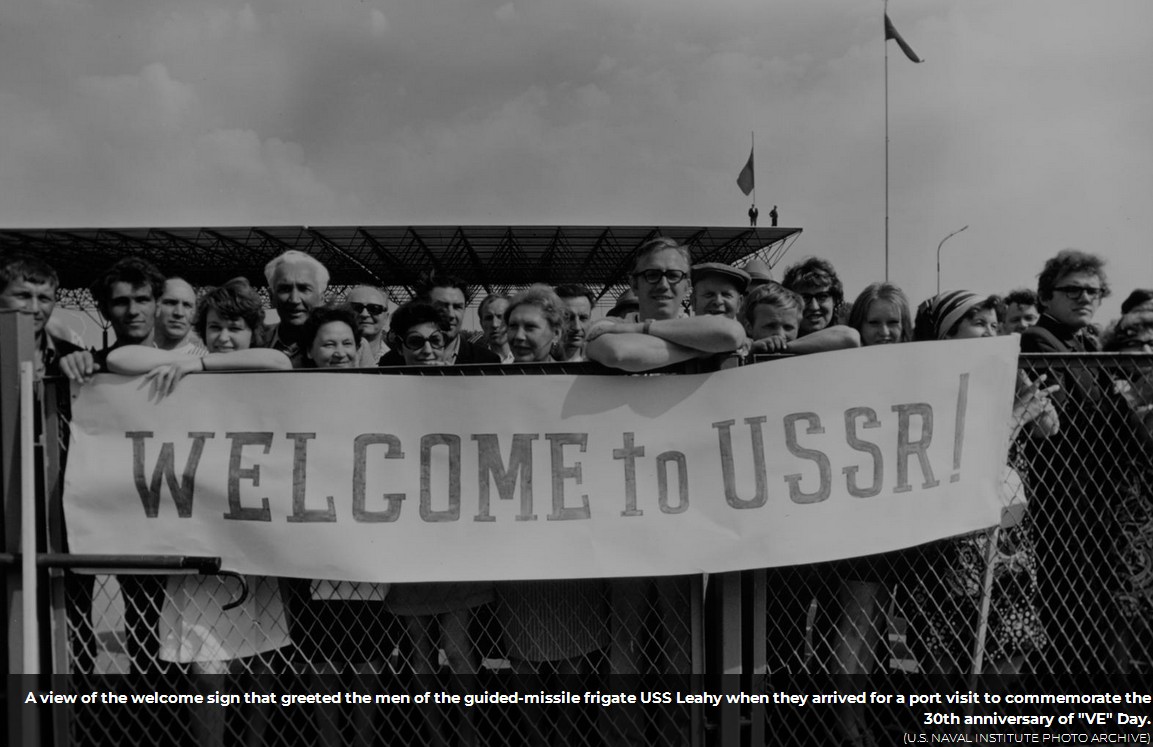
|
Back in the U.S.S.R.
Remembering a historic, groundbreaking port call to Leningrad by the USS Leahy and USS Tattnall
in 1975.
By Captain James “Ros” Poplar III, U.S. Navy (Retired)**
June 2022 - Naval History Magazine - https://www.usni.org/magazines/naval-history-magazine/2022/june/back-ussr
Upon commissioning from the University of Mississippi in 1974, I was assigned as the gunnery officer in the USS
Leahy (DLG-16). She was the lead ship of her class and known in the day as a “double ender.” She was equipped with
terrier missile batteries both fore and aft, and her sleek lines spoke of strength and power. Her Joint Army/Navy/Air
Force Publication call sign of “Defender” was a fitting tribute to this fine ship-of-the-line.
While under seasoned hand of her commanding officer Captain (later Rear Admiral) Alexander M. Sinclair Jr., a former
white hat, and both a diesel boat and frigate CO, the Leahy was designated as “Top Gun” of the Atlantic Fleet.
This was based on her unbroken string of Battle Efficiency “E’s” and her prowess during numerous successful missile
engagements in the annual Atlantic Fleet Readiness Exercises.
All were proud to be a part of her tight-knit crew, who affectionately referred to her as “Sweet Sixteen.” In 1975,
the Leahy was the subject of a U.S. Navy recruiting campaign featuring the “new” enlisted uniforms (fortunately,
they were short-lived). She was berthed on the Norfolk waterfront adjacent to the numerous “locker clubs” that
dotted the strip outside the main gate, where authorized sailors would change into their “civvies” before going
on liberty. However, many Leahy sailors opted to remain in uniform while on liberty so that their USS Leahy patch,
a badge of honor, would be prominently displayed on the shoulder.
To put the time period in perspective, the late 1960s and early ’70s marked the height of the Cold War between
the United States and the Soviet Union. Not only was the rhetoric at a fever pitch, but there were routine confrontations
both at sea and in the air between both navies, resulting in the Incident at Sea Agreement, which attempted to
reduce the tension level between naval forces of the United States and the Soviet Bear. Meanwhile, there was a
movement underway by the leadership of both countries that detente vice confrontation would better serve the interests
of both nations.
Soviet Sailors in Boston and Americans in Leningrad: First Exchange Visit in 30 Years - The New York Times (nytimes.com)
In that spirit, in 1975 President Gerald Ford and Premier Aleksey Kosygin agreed to a ship exchange between the
U.S.A. and the U.S.S.R. in May to commemorate the 75th anniversary of victory in Europe in World War II, VE Day.
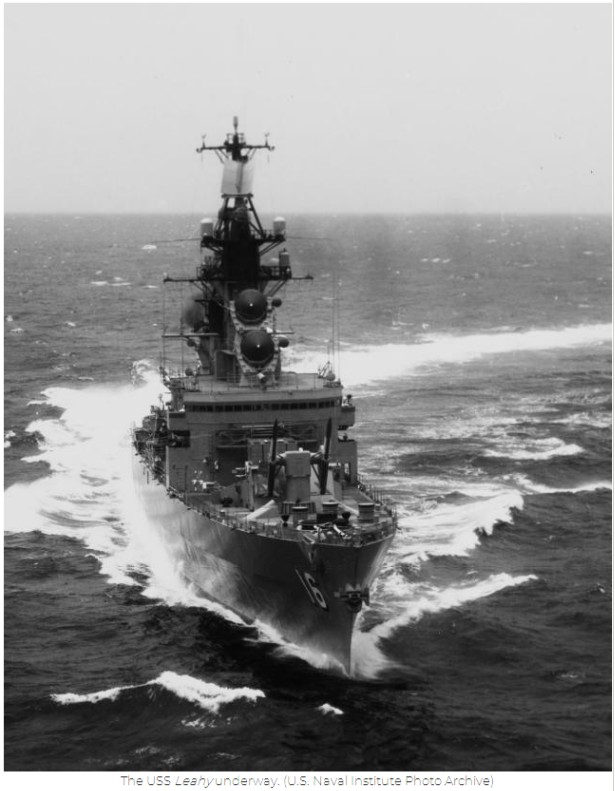
Early in the spring of 1975, the Leahy was notified that she and the USS Tattnall (DDG-19) would
be the U.S. ships participating in the exchange while en route to a scheduled six-month Mediterranean deployment.
We were told that our type Commander Naval Surface Forces Atlantic (COMNAVSURFANT) was counting on us to “put on
a good show.”
Sprucing Up the Quarterdeck
As the Leahy’s “gun boss,” one of my responsibilities was our quarterdeck, and COMNAVSURFLANT wanted to ensure
the U.S. Navy put our best foot forward. In doing so, I was provided with a letter stating that I was entitled
to “borrow” any item I needed from any ship berthed in Norfolk to spruce up our quarterdeck. I took advantage of
this entitlement on short order. Needless to say, when we departed Norfolk for Leningrad, I left some very disgruntled
commanding officers in our wake. Like any good fleet sailor, I had taken full advantage of my license to “borrow.”
In addition to acquiring hardware, as we got closer to the day of departure for our pending visit, we acquired
new members in the ship’s company. My division consisted of nine gunner’s mates. However, reporting to quarters
the day before departure, I was astounded to see that standing in formation were approximately 30-plus new members
of Second Division. I asked Gunner’s Mate Senior Chief Hobbs, “Senior, what the heck is going on?” And he promptly
responded in his slow Georgian drawl, “Mr. Poplar, just don’t not ask any questions.” As it turned out, my new
“gunner’s mates” were actually cryptologists, or “crypies,” embarked for the port call incognito so as not to draw
attention to their presence while collecting intelligence on our potential adversary.
In addition to an extra complement of “white hats,” the wardroom was augmented by several Soviet experts, including
Captain William H. J. Manthorpe, author of the then go-to source The Guide to the Soviet Navy. Captain Manthorpe’s
position was to function as our trained eyes and ears for the pending visit. He and his staff provided numerous
briefings to the crew en route to Leningrad on such topics as what to expect during our visit and how to react
if a member of the Soviet military or a civilian declared they wanted to defect once on board the Leahy. Luckily,
this did not happen, although it was highly anticipated. In addition, we embarked Commander Cruiser Destroyer Group
Eight Rear Admiral Justin E. Langille and his entire staff—we knew this would not be your everyday port visit!
Prior to making destination in Leningrad, we stopped briefly in Portsmouth, England, for a final round of “titivation”
and a full-dress rehearsal for entering port, including a carefully synchronized 21-gun salute. Of course, as the
new gunnery officer, I dreaded the thought of having one of the saluting batteries misfire and being responsible
for causing, as the weapons officer put it, an “international incident.” No pressure for a newly minted ensign!
Our passage through the Gulf of Finland proved to be uneventful, but as we drew closer to our ultimate port of
call, you could feel the tension level increase dramatically—“sweat pumps” coming online, as one on the deck plates
would say. As Leningrad came in sight, we were met by a Riga-class destroyer flying the international flag hoist
for “follow me,” which we and the Tatnall did smartly in a “formation one,” or column at standard distance (1,000
yards). We were in awe as we passed directly by the island naval base at Kronstadt , where the might of the Soviet
Navy was moored right off of our port beam. It was an incredible sight that I will never forget, with ships that
I had only seen in Janes or other publications standing tall and the crews manning the rail as we each rendered
honors to mark this historic day.
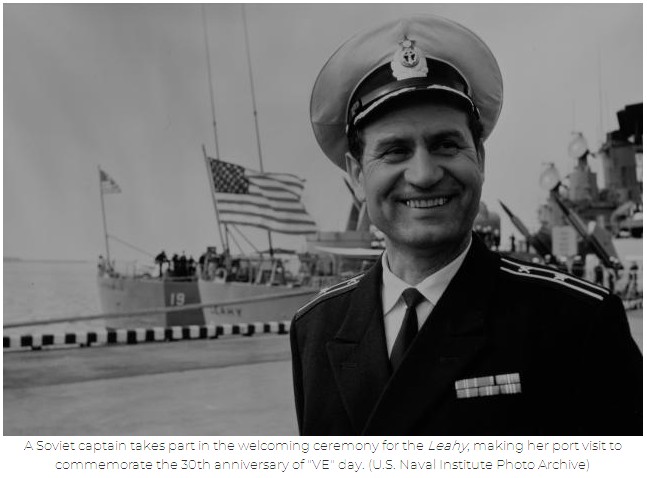
Dueling Anthems at Dockside
Our mooring in Leningrad was uneventful, and we prepared for a hopefully uneventful five-day port visit. It soon
became apparent that there was a strong competitive spirit between the two navies to outdo each other. Morning
colors in the Leahy became a complex and carefully choreographed ritual where, like clockwork, all four Terrier
missile-training shapes (or “TSAMs”) both fore and aft were run out simultaneously on the launcher rails along
with the smart execution of full-dress ship (signal flags hoisted the length of the ship). An honor guard in full
dress all executed smartly to the strains of “The Star-Spangled Banner” blaring topside from the 1MC. This was
then followed by the playing of the Soviet national anthem at full volume on the pier.
We did find it odd that we were berthed directly next to a warehouse that ran the full length of the pier. We later
found out that, during our visit, both electronic- and radiation-monitoring equipment had been placed in the building
to track our activities. Even though we were a nuclear-capable weapons platform (both terrier missiles and antisubmarine
rockets), those were the days of “We can neither confirm nor deny . . .” and you know the rest. In addition, we
learned that during our stay, without the benefit of submitting a formal work request, Soviet divers conducted
a non-scheduled hull inspection of both ships to gather intelligence on their potential adversaries.
During our stay, liberty during the day for both the wardroom and crew proceeded without incident and included
sports competition, tours of the Soviet Naval Academy, the Hermitage, the battleship Aurora, and other sights,
always with the implication from our tour guides that it was Russia, not the United States, that had been responsible
for the defeat of Nazi Germany. At night, we were treated to the Kirov Ballet, multiple formal dinners with numerous
toasts and presentations, where we learned that, while we junior officers were imbibing some extraordinarily strong
vodka, our counterparts were surreptitiously substituting water for their toasts.
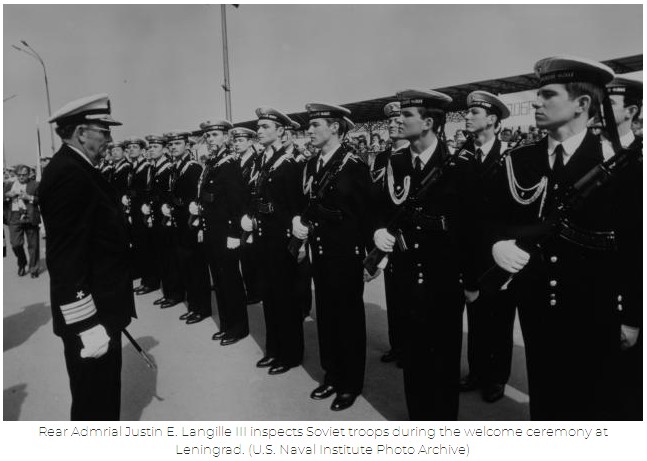
Tailed by the KGB
After several days of structured shore leave and liberty, we were allowed to tour Leningrad on our own. “Our own”
meant that, from the moment we left the pier, we were constantly followed by KGB “tails,” and as any junior officer
would do, we made it a game to see if we could shake them. To their credit, our “hosts” kept us in eyesight for
the duration of our outings no matter how hard we tried. In addition, we were warned of the possibility of KGB
“honey pots” that would be placed before us, but to the chagrin of most of our junior officers, none were encountered.
Throughout the port call, we experienced visits from numerous Soviet dignitaries who were impressed during “sanitized”
tours not only with our then state-of-the-art technology but also with our damage-control capabilities—a capability
that the Soviet Navy did not emphasize. In addition, we were treated by a visit by Elizabeth Taylor and Johnny
Mathis, who happened to be filming a movie in Leningrad. I had the pleasure of having lunch with both and can testify
that Elizabeth Taylor’s striking blue eyes were as hypnotic in person as they are on the screen.
During our stay we were opened for ship tours by the local populace. Admittance was solely by ticket after careful
screening by the KGB. In those two days we had thousands of locals come aboard; most had a rudimentary command
of English and were always eager to strike up a conversation. They were all extremely friendly and, most up-front,
stated their respect for the United States, as well as a desire to own our products, such as Levi’s jeans. Barter
soon became the bond between us. I still have many mementos from that visit, such as a Soviet Navy belt buckle,
“Donald Duck” enlisted cap, and qualification badges, all of which I treasure to this day.
The only incident of the stay occurred the night before we were scheduled to set sail. Liberty expired at midnight
(“Cinderella Liberty”), and one of our operations specialists was not accounted for despite repeated musters and
a search of the ship from stem to stern. Operational reports soon were released, but just as we were singling up
our mooring lines at sea detail, the prodigal shipmate came running down the pier. Evidently, he had overslept.
I let you draw your own conclusions . . .
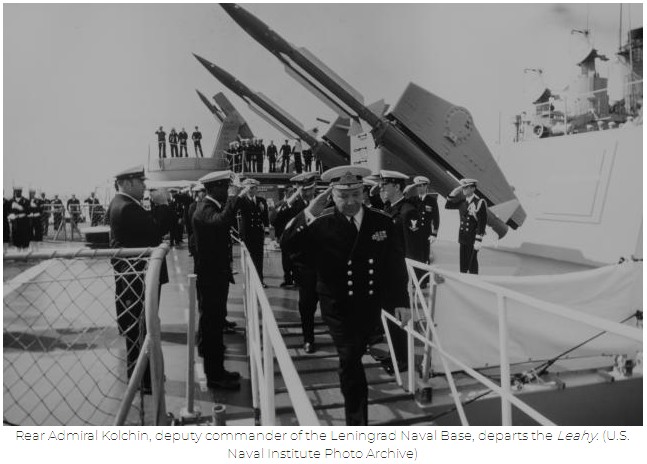
‘All Sailors at Heart’
In summary, the mission of the U.S./U.S.S.R. ship exchange in 1975 was achieved. At least on the deck plates, we
understood that, regardless of the differences in our respective political ideologies, we were all sailors at heart
and that, as in the days of Commodore Perry, diplomacy sometimes can be executed better by American Bluejackets
than by high-paid diplomats. I can only hope that, in some small way, a port visit by two American destroyers almost
50 years ago contributed to the fall of the Berlin Wall and eventual breakup of the Soviet Union. At least I like
to think it did.
As we departed Soviet territorial waters at best speed (34 knots) with all four 1200 PSI boilers on the line, you
could hear the refrain of the then-popular Beatles song “Back in the U.S.S.R.” being played at full volume by one
of our boatswain’s mates on the fo’c’sle as he sang at the top of his lungs, “I want to go back to the U.S.S.R.”
I could not have agreed more—it had been a historic port call smarty executed by fleet sailors with both style
and panache.
|
**During 30 years as a surface warfare officer (1110), CAPT. Poplar commanded two ships and an amphibious squadron, He has served on
the Joint Staff, the SECNAV Staff, and the OPNAV Staff. He attended the U.S. Army War College and has taught at
both Vanderbilt University and the National Defense University. http://www.ussleahy.com/LeahyPhotos.html
|

|